Between Snapchat updates and Instagram implementing similar features to the app, many users have stopped using Snapchat. Although the number of users has decreased, Snapchat still has 187 million active daily users. So, is Snapchat still a relevant platform for marketing? Yes, and here’s why.
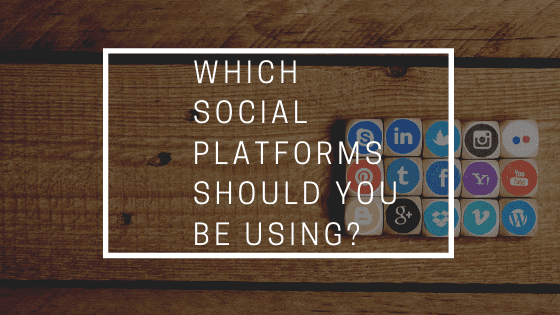
As a business, you want to make sure that you’re doing everything in your power to stay relevant in order to keep growing in your industry, and the best way to do this is by taking advantage of social media platforms. While you might be familiar with Facebook, Instagram, Twitter and Pinterest, do you know which ones are going to help your company? You probably know that you don’t necessarily have to have an account for all of them, but you do have to make sure that you choose wisely on what platforms you’re going to decide to use.
These platforms all have their benefits, but there are some specific ones that you’re going to want to focus on if you want to help your business thrive. Here are the social platforms that professional marketing companies suggest you try utilizing based on your needs.
Twitter: Twitter is going to benefit your company if you want to provide your consumers with breaking news, announcements and other important and time-sensitive information. Easy, digestible text thrives on twitter and marketing companies recommend this platform for businesses who are based around immediacy.
LinkedIn: B2B businesses should have a LinkedIn account because it will help with lead generation. This platform can help you establish your company as a trusted leader in your field by posting a lot of editorial content. Marketing companies have also pinned down that the demographic on LinkedIn ranges widely from the 30-49 age range.
Pinterest: If your brand uses lots of images within your content, Pinterest is going to be the number one platform that you should be using. Marketing companies have found that 90 percent of users plan purchases while on Pinterest, so this graphics-heavy site is good for driving sales.
Facebook: This is the largest platform to date. With over two-billion users, Facebook is another great platform for lead generation, and it can also be beneficial to your brand in terms of building relationships and showing consumers the human side of your business. It is worth noting, however, that since Facebook is the largest platform, there is also going to be a great deal of competition on this platform.
Instagram:Once again, Instagram is a photo-focused platform, and you’ll want to create an Instagram account for your brand if you’re planning on showcasing your work.
These different platforms are great for different reasons, but you should narrow down your options to avoid wasting any valuable time trying to create a presence where it isn’t needed. If you’re looking to get some help establishing an online presence, give us a call here at Fusion 360.
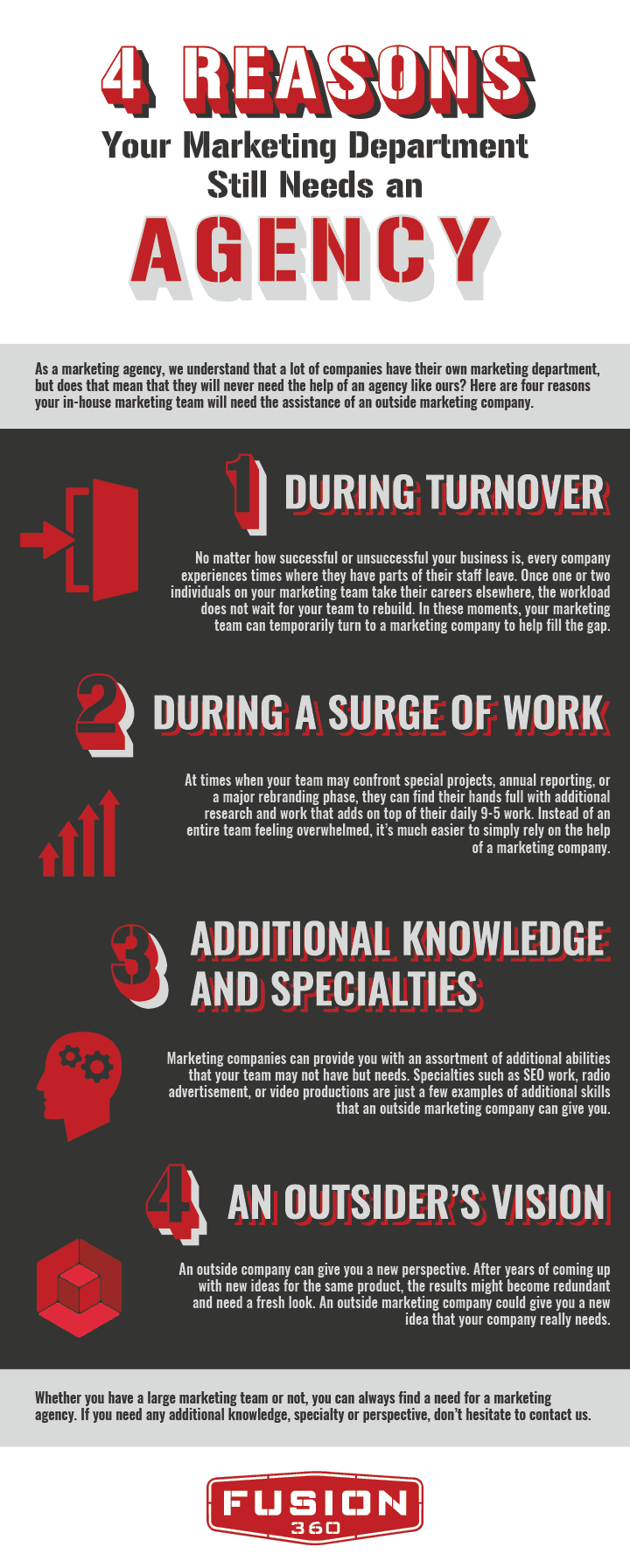
As a marketing agency, we understand that a lot of companies have their own marketing department, but does that mean that they will never need the help of an agency like ours? Absolutely not. Here are four reasons your in-house marketing team will need the assistance of an outside marketing company.
During Turnover
The first and absolute, no arguments about it, time that an in-house marketing department will need to outsource some of their work is during turnover. No matter how successful or unsuccessful your business is, every company experiences times where they have parts of their staff leave. Once one or two individuals on your marketing team take their careers elsewhere, the workload does not wait for your team to rebuild. In these moments, a marketing team can temporarily turn to a marketing company to help fill in the gap.
During a Surge of Work
There are moments when your team might confront special projects, annual reporting, or a major rebranding phase. At these times, an internal team can find their hands full with additional research and work that adds on top of their daily 9-5 work. To help your team avoid late hours and high amounts of stress, outsourcing your work will ensure that all the routine work is finished in a timely manner and the special projects get the focus and work that they need. Instead of an entire team feeling overwhelmed, it’s much easier to simply rely on the help of a marketing company.
Additional Knowledge and Specialties
An in-house marketing team is likely to have the talent they need in order to run their social media platforms, create strategies to increase their list potential clients/consumers, and even continue to develop their website or app, but what about other marketing specialties? You can find an assortment of marketing companies that provide you with additional abilities that your team doesn’t have but needs. Specialties such as SEO work, radio advertisement, or video productions are just a few examples of additional marketing skills that an outside marketing company can give you. Like we said, you may have talented individuals that can create plans and strategies, but there are other areas that you will want to rely on the experience and knowledge of others.
An Outsider’s Vision
Along with the additional knowledge and specialties that an outside agency might give you, they can also give you a new perspective. While your company and its employees may know their own selling point, content and functions unlike anyone else, this can sometimes blind you. After years and years of coming up with new ideas for the same product, the results might become redundant and need a fresh look. An outside marketing company could give you a new idea that your company really needs, but without taking the chance to outsource your work, you will miss out on the opportunity.
Whether you have a large marketing team or not, you can always find a need for a marketing agency. If you need any additional knowledge, specialty or perspective, don’t hesitate to contact us, Fusion 360.
Before you get into the advertising or marketing business, you need to know the basic mechanics of how a marketing agency works. Marketing companies come in all shapes and sizes, but most follow a similar structure that has been proven to work, no matter how many people they hire. Smaller companies will often have one person wear multiple hats, or one person that does everything an entire department would. Larger agencies will have each department broken down for efficiency. Either way, the fundamentals for the ad agency model works. Here at Fusion 360, a digital marketing company, we know how important the different roles are to build an effective agency. Here are some of the key roles:
Account Director/ Manager
Management of a marketing company is extremely important. Without a solid manager, the whole ship will go down before it even gets going. An account director or manager is responsible for managing the agency’s relationship with its clients and accounts. The account director is the one who delivers the creative work and content to the client and makes sure it fits their wants and needs. They deal directly with the client to address any problems that may arise and develop a solid long term relationship with clients.
Web Developer/ Web Designer
Web developers are programmers who create applications and programs for their clients’ websites. These individuals are well versed in many different program languages, such as HTML, CSS and creative software. It is important to find a web developer who is skilled enough that they can create custom codes and build a website from scratch. A marketing company that really wants to do well will definitely need a web developer to run their websites and make sure everything online functions properly.
A web designer is similar to a web developer, though, their skills may not be as in-depth as a developer. A web designer typically has both technical and creative skills. They focus more on making websites aesthetically pleasing and functional for easy use.
Social Media Manager
The social media manager is responsible for managing all social media marketing. A social media manager has to be acutely aware of social, cultural and digital marketing trends as they constantly evolve. A social media manager has to be an expert in communication in order to attract and engage their target audience. They also have to be pretty creative in order to create quality content in the form of texts, images and video. Marketing companies need a social media manager to stay up with trends and market their brand socially.
Graphic Designer
Graphic designers are in charge of creating all the visual content to market the brand. They come up with ways to get messages across in print and digital media through color, imagery, text and formatting. Graphic designers are in charge of the overall digital marketing projects.
No matter the position, each is essential to make a marketing company really work. There are more roles that can be filled at a marketing agency but these are just some of the major ones for any size agency. Here at Fusion 360, we understand how important each role is to build a great marketing company. If you are wondering how to get involved in the advertising or marketing, reach out today and we will help you!
Working with any other company can be a little scary, however, going through a few simple questions can give you loads of relief. In this case, we assume that you are looking to work with a marketing company, but where do you start?
Below is a short list of questions that you need to ask yourself as you go about trying to find the right company for you.
QUESTION #1 — What Needs Do You Have?
If you are looking to hiring a marketing company to help bring more attention to your company or product, you probably have a variety of needs, but what are they? Are you looking to promote a specific product or service? Are you trying to establish your brand among potential clients/customers? Are you wanting to gain an online advantage over competitors? Or are you in need of professional help with video producing and social media? Marketing companies usually have a particular niche with something like video production, digital content, social media or product expertise. Whatever your needs are, you want to match that need with a fitting agency. Educate yourself on what capabilities these agencies have and how they might be a benefit to you.
QUESTION #2 — Who will Manage Your Account?
When you start allowing others to take on a role of representing your company name and product, it can take a minute to feel comfortable with it, after all, your product is your baby in a way. You wouldn’t let just anyone babysit your child — you need to find individuals that you trust. Whether it’s a babysitter or a marketing company, you will have a lot more confidence leaving your prized-possession in the hands of someone experienced and responsible. Try to find reviews or any other indicator that measures the quality of work of the agencies you are looking at.
QUESTION #3— Do They Communicate and Deliver on Their Services?
When you choose to outsource your marketing, the price you pay better be worth it. What services do they offer and are they able to back it up? A good indicator of this is how well they communicate with you. If they are responsive and punctual in initial meetings and communications, then they will likely stick to that consistency. If there are any foreboding signs, you may be wise to follow them.
QUESTION #4 — What will the Contract Consist Of?
Going right along with being confident in their services, be sure that the contract gives you everything you want. This includes things such as performance indicators, no hidden fees, and secret cancellation processes. You will be bound by a contract and, to avoid any future disaster, give yourself the surety that you are not getting involved in anything you don’t want to be.
Like we said before, hiring a marketing company can be a little daunting at first, but asking yourself a few of these questions will go a long way. When you are able to answer these questions with confidence, you won’t have any trouble. If you are looking for the right marketing company for you, contact us, Fusion 360.
The new word, “Meme,” is one that you’re going to hear more and more in this day and age, and whether you know about them or not, they engage their viewers. Facebook, Instagram and Twitter are littered with memes; you probably scroll past hundreds of them every day. While they might just seem like silly pictures with clever captions, did you know that marketing companies use them to create a better connection between their clients and consumers?
Since memes are so popular today, marketing companies have figured out that they can utilize them to their advantage. If people are going out of their way to look at memes, and if they’re so prominent on social media platforms, why not take those memes and fit them to your brand? Here are some ways you can utilize memes to increase your engagement.
They Act as a Mild Form of Advertising
Advertising isn’t always received in a positive manner, and this generation is finding new ways to block and ignore online ads. However, memes are tailor-made for social media content. This makes your post — or “ad” — feel genuine and therefore easier to engage with, share, and attract more attention with very little effort. This is where companies can capitalize on creativity, or else, they can find themselves suffering in terms of engagement. Marketing companies, for example, take advantage of their appeal — humor and entertainment — and use it as a method of grabbing and retaining the consumers’ attention.
Memes Can Make “Boring” Subjects Entertaining
If you’re looking to connect with a younger audience, memes are going to be your best friend. However, there is one thing that you need to remember before you start creating memes — they HAVE TO be funny. Memes rely heavily on humor, and if you don’t have that in the mix, you’re going to see very little engagement; always aim for the quick laugh.
Something to Look Out For
When you create a meme in the hopes of producing a reaction, they need to be current/relevant to what’s trending, sharable, easy to digest, simple to read, and straight to the point. We can’t emphasize enough that memes have a very short lifespan. They usually come in waves, and you cannot show up late to the party.
Memes are great because they provide a comical value to your brand, which appeals to a large audience. If you’re wanting to add that extra oomph to your social media game, make sure to check out some memes that you could potentially use — just make sure you’re keeping up with what’s in and what’s not.
It’s become standard for video production companies to shoot their videos at 24 frames per second, but are there other frame rates that you can utilize to make sure that you create the best quality video possible? It’s been known in the video production world that this number is used because it’s the best way to give your video a more cinematic look.
Surprisingly, shooting in this frame rate is actually an old cinema method that’s been used for decades. So, that answers the question, why? There’s no reason that video production companies should even bother shooting in other frame rates, right? While this frame rate might work for a majority of video productions, there are a few occasions where recording a video in other frame rates is a more viable option. Here are some situations where you’ll want to shoot using a frame rate other than 24 frames per second.
Shooting Animations
Classic animators had to draw all their animations by hand, which is why they opted to shoot their animations at 12 frames per second. If you’re wanting to shoot classic style animations, you’re going to want to shoot at said 12 frames per second.
Sitcom and Commercial Style
Thirty frames per second is going to be your best friend if you’re wanting to shoot something that mimics a home movie or sitcom. While video productions shot at 60 frames per second, the previous standard shot at 30 fps. Many video production companies would agree that shooting at 30 or 60 fps allows the shot to feel a little more smooth and capture personal interaction better. For that reason, some commercials are also shot at 60 fps to capture the emotion.
Live Action and Sports
Sports and other live action broadcasts require slow-motion, which needs to be shot at a much higher fps. To see the sideline catch of a football game or if a players toe was on the 3-point line at a basketball game, cameras will need to be able to shoot up to at least 120 or 240 frames per second. More recently, these sporting events are shooting at an astounding 300 frames per second to capture super slow-motion shots.
Video production companies use different frame rates for different video productions, and it’s important for you to know which frame rate will work best for you. If this guide hasn’t answered all your questions, or if you’re just looking for a reliable video production company to help you with your next project, give us a call.
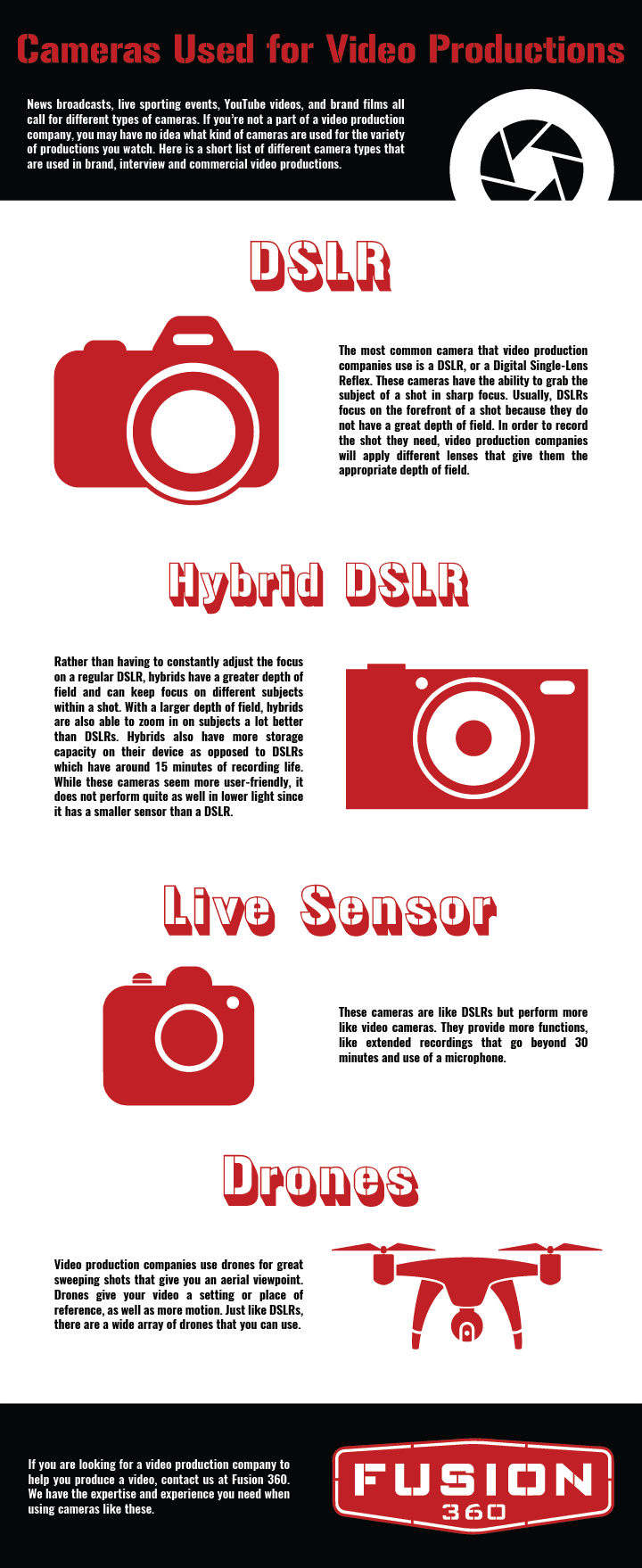
With visual images at an all-time high, cameras are used now more than ever before. News broadcasts, live sporting events, YouTube videos and brand films all call for different types of cameras, and the thing is, if you are not apart of a video production company, you may have no idea what kind of cameras are used for the variety of productions you watch. Here is a short list of all the different types of cameras that are used in video productions.
**Disclaimer — we are specifically talking about cameras that video production companies use to shoot brand videos, interviews and commercials, not news broadcasts, live sporting events or movies**
DSLR
The most common camera that video production companies use is a DSLR, or a Digital Single-Lens Reflex. Anyone that is starting to create their own videos will want to use a DSLR. There are different types of DSLR cameras but they ultimately have the same function: the ability to grab the subject of a shot with a sharp focus. Usually, DSLRs focus on the forefront of a shot because they do not have a great depth field but can capture high-quality images on the area they are focused on. In order to record the shot they need, video production companies will apply different lenses that give them the depth they need.
Hybrid DSLR
The hybrid version of DSLR cameras differs in quite a few ways. Rather than having to constantly adjust the focus on a regular DSLR, hybrids have a greater depth of field and can keep focus on different subjects within a shot. With a larger depth of field, hybrids are also able to zoom in on subjects a lot better than regular DSLRs. Further, hybrids have more storage on their device; DSLRs have around 15 minutes of total recording life. While the hybrid seems a little more user-friendly with its greater depth and longer recording life, it does not perform as well. Don’t take this wrong, hybrids can still capture amazing images, but they have a smaller sensor than a DSLR and therefore do not do as good in lower light.
Live Sensor
These cameras are like DSLRs but perform more like video cameras. They give you more functions, like extended recordings that go beyond 30 minutes and the use of a microphone.
Drones
To continue to show that there are different types of cameras based on the video’s purposes, we will briefly discuss drones as well. Video production companies use drones for great sweeping shots that give you an aerial viewpoint. Drones give your video a setting or place of reference, as well as more motion. Just like the DSLR cameras, there are a wide array of drones that you can use.
Conclusion
These four cameras are just several different types that are utilized when making promotional videos for other businesses, but there are even more cameras out there that are used for movies and live events. If you are looking for a video production company to help you produce a video, contact us at Fusion 360. We have the expertise and experience you need when using cameras like these.
As you sit and watch your favorite movie or TV show, you probably don’t think about how much work or planning was put into creating it. How long did it take them to film? How difficult was the editing process? Who came up with the idea or script? Depending on the type of film, video production companies spend a good amount of time planning, filming and editing. From the storyboard to the big screen, here’s how your favorite videos and movies are made.
Pre-Production
Although you might think that a good film starts with a storyboard, this step actually comes a little bit later in the pre-production stage. Before a storyboard is created, there are a few other things that need to be decided first.
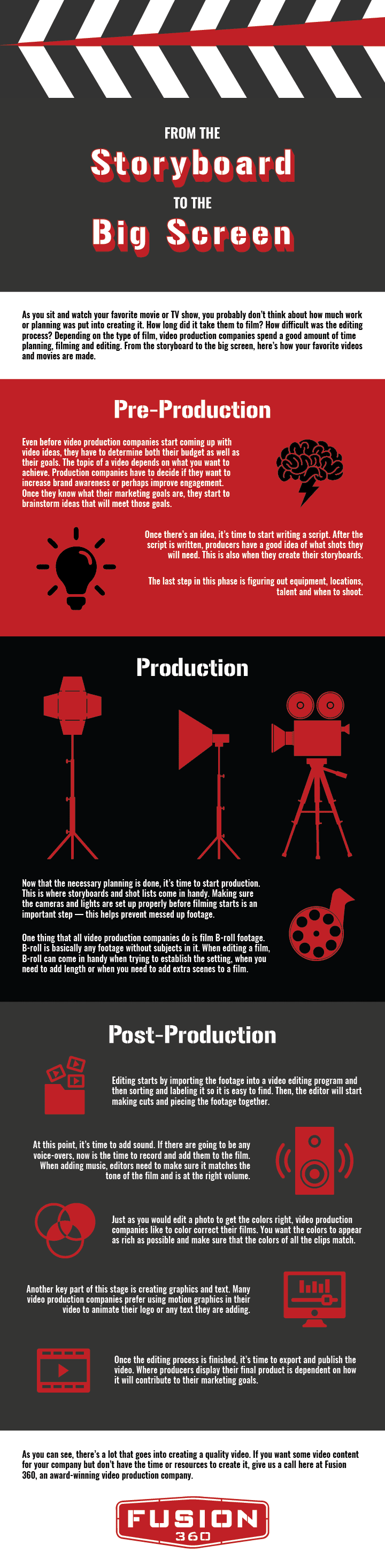
Even before video production companies start coming up with video ideas, they have to determine both their budget as well as their goals. The topic of a video will depend on what you want to achieve. Production companies have to decide if they want to increase brand awareness or perhaps improve engagement. Once they know what their marketing goals are, they then start brainstorm ideas that will help meet those goals.
Once there’s an idea, its time to start writing a script. After the script is written, producers have a good idea of what shots they will need. This is also when they create their storyboards.
The last step in the pre-production phase is figuring out equipment, locations, talent and when to shoot.
Production
Now that all the necessary planning is done, it’s time to start production. This is where storyboards and shot lists come in handy. An important step is making sure the cameras and lights are all set up properly before filming starts so that the footage doesn’t get messed up.
One thing that all video production companies do is get B-roll footage. B-roll is basically any footage without subjects in it. When editing a film, B-roll can come in handy when trying to establish the setting or even when you need to add some length or extra scenes to a film.
Post Production
After everything has been filmed, its time to take it to the post-production phase. Now, editing isn’t just piecing the clips together and adding some music behind it. Many of the aspects you love in your favorite movies are created in post.
Editing starts by importing the footage into a video editing software and then sorting and labeling it so it’s easy to find. Then, the editor will start making cuts and piecing the footage together.
At this point, it’s time to add sound. If there are going to be any voice-overs, now is the time to record and add these to the film. When adding music, editors need to make sure it matches the tone of the film and is at the right volume.
Just as you would edit a photo to get the colors right, video production companies like to color correct their films. You want the colors to appear as rich as possible as well as all the clips to match, so colorists will come in and play with the colors on a few clips to make them all match.
Another key part of this stage is creating graphics and text. Many video production companies prefer using motion graphics in their video to animate their logo or any text they are adding.
Once the editing process is finished, it’s time to export and publish the video. Where producers display their final product is dependent on how it will contribute to their marketing goals.
As you can see, there’s a lot that goes into creating a quality video. If you are wanting some video content for your company but don’t have the time or resources to create it, give us a call here at Fusion 360, an award-winning video production company.
Just like any other industry, filmmaking comes with its own unique vocabulary. Amongst the odd terms and references you’ll hear when working with video production companies, you might think one thing means something, but it will mean the complete opposite or even something that wouldn’t make sense. The thing about these bizarre terms is that almost everybody who works in video production companies knows what they mean, and they actually act as a rite of passage that every filmmaker must go through.
So, if you’re new to the world of video production or just want to know what everyone on set is talking about, here are some of the most bizarre terms for objects and people that you might find while you’re working with video production companies.
A “Baby”
When you hear “I need a baby,” or “can somebody get me a baby?” while on set, it might seem a bit odd. Video production companies don’t actually use human babies for their video production projects, they’re referring to a small set of tripod legs. These small tripods allow filmmakers to put their cameras closer to the ground, allowing for low-angle shots.
A “Cheese Plate”
This one can be especially tricky if you’re on set and you happen to be hungry, but when someone asks for a “cheese plate,” you’re going to be disappointed when they bring out a metal plate with holes in it. This piece of equipment serves as a multipurpose utility bracket that comes in various shapes and sizes. They’re oftentimes used to create camera rings.
A “Dead Cat”
No need to panic, when a videographer asks for a “dead cat,” they want a fuzzy cover that goes around the end of a boom mic in order to block out wind distortion. The reason they call this accessory a “dead cat” is because the fuzzy exterior makes it look like a cat.
A “C-47”
When you hear the word “C-47,” you might think of an advanced camera, a high-end mic, or a fancy lens, however, a C-47 to a video production company refers to… a clothespin. Yes, that’s right, the term that originally comes from a C-47 aircraft is used in the world of video production to refer to a clothespin. There still isn’t a clear answer as to why this is, but most people say that it’s because of the item’s versatility.
These terms are…peculiar, we know. If you aren’t apart of the video production world, it’s perfectly normal if you are left scratching their head, but if you want to understand what’s happening on a set, be sure to learn everything you can about all the bizarre film terms.